
Click on
Library Icon
to learn more
|
Teaching "On Your Mat"
Teaching
"Go to place", "On
your Mat", "go to
bed", "settle" or any other term you
choose that tells your dog to
"settle" on a special bed, towel,
mat or rug, preferably one that is
portable - easy to move from
place to place.
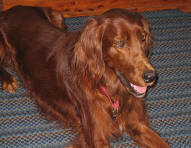 You may find using one word works
best such as, mat, bed, etc.
Many people, say, "Kennel"
to cue their dogs to go inside a kennel. You
will want a different term such as, "Place" or "Mat" for when his
bed is outside of the kennel. You may find using one word works
best such as, mat, bed, etc.
Many people, say, "Kennel"
to cue their dogs to go inside a kennel. You
will want a different term such as, "Place" or "Mat" for when his
bed is outside of the kennel.
It is
okay to extend the cue to "On your mat" or
"Go to mat" as long as you are
consistent, saying the exact words -
preferably in the same even tone,
and with the same body language or
hand signal -
each time. When giving any Instruction, use the same voice tone
each time and link the Instruction to a
hand signal. Dogs typically learn a
hand signal faster than a word. Again, keep your body
language consistent when giving
Instructions. This helps your dog to
learn much faster.
|
The goal is to go slowly and
keep it enjoyable for the
dog.
Be
gentle, use a happy tone,
lots of praise, and
intermittent treats. |
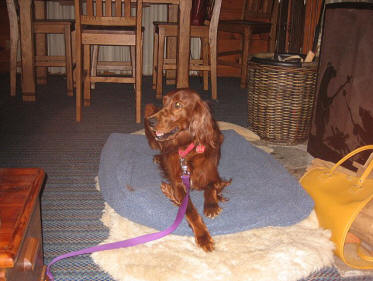
Start this lesson with a soft cushy bed
placed near you and put a leash on
your dog.
Each time you take him and encourage
him to choose the soft bed over the
hard floor, also give
him the words and signal for "on your
mat" as he walks up on the
bed.
 Now we
will begin to add different training
techniques to reinforce the verbal
Instructions: Now we
will begin to add different training
techniques to reinforce the verbal
Instructions:
1. Any time your dog freely goes to the
bed on his own, add the Instruction and
reward him.
2. Then try to predict when he
will walk to his bed so you can
add the cue (words) sooner.
When he is several steps away give
the word.
3. After 6-12 times, add the
cue when he is further away, but
you are fairly certain that's where
he is going.
4. You can also set it up where he
will want to go to the bed! Tether
him (leash attached to something
heavy near the bed) across the room.
Show him a food puzzle or treat,
place it on the bed. Untether him
and as he goes to get the treat,
give the Instruction.
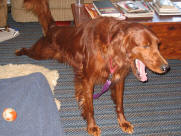 5. When he is
in another room, place a treat/food
puzzle on the bed, then go to him
and give the Instruction. Be ready to
lead him to the bed if he doesn't
"get it" the first few times you
asked from a different room. 5. When he is
in another room, place a treat/food
puzzle on the bed, then go to him
and give the Instruction. Be ready to
lead him to the bed if he doesn't
"get it" the first few times you
asked from a different room.
6. Last step = give the Instruction
when there are distractions, such as
someone knocking at the door, or you
are fixing his dinner.
Test it out! = from different
rooms, different places with
distractions and move the bed
to different rooms.
Check out this
wonderful youtube video on teaching
settle on a mat! This can be
done with or without a clicker.
https://youtu.be/Yne2oR0lUCo Another Instruction to introduce is the
"wait" Instruction which means the dog
can be in any position but needs to
remain in an area - on the mat, in
the car, or in a room. Stay means
to hold a specific position until
released or asks to change
positions. You
can reinforce the "wait"
cue with close tethering. The wait
cue is also used when you leave
the dog in a car, or ask the dog NOT
to dash out of a door until you have
gone through first and then given the dog
permission to cross the threshold.
|



 Print
Print Improving Relationships
between People and Pets!
Improving Relationships
between People and Pets!