|
Need Help?
|
|
Call
1-800-372-3706
to
speak to a Veterinary Behavior Technician |
|
Paws To Speak!
Member
Main Menu
|
|
More "Learn to Earn"
Lure-Reward
Training Video
.jpg)
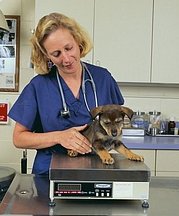
Pet Professional Tip
Teach
the dog to sit for treats on the scale, and
before
letting the dog out of the run or kennel for an
outdoor break.
Praise and treat quiet, dogs. Ask dogs
to sit and wait so that they don't rush out
of runs.
|
 |
|
Help is at your
fingertips by library, email and
phone. |

Click on
Library Icon
to learn more
|
Helping a Dog "Learn" to Earn Food
and Attention
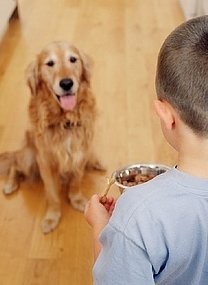 Introduction Introduction
Because we love
dogs, there is a natural tendency to pamper them. We think it's cute
when they show us what they want and so we respond by giving it to
them. Many dogs misinterpret this loving generosity. Some dogs learn
to get what they want by trying to control their humans.
Following the leader
Since dogs are
genetically evolved from wolves, their instinct is to participate in
a family pack hierarchy. By instinct, dogs learn how to meet their
basic needs by trial and error.
Much has been written about dogs viewing
their human families as their packs. Although the pack comparison is
not exact, dogs are social and generally learn who is in charge of
the valued resources.
Dogs are better behaved
when they learn that people are gentle, trustworthy and control what
the dog wants and needs to survive and thrive in a human household.
When dogs learn - by accident - to take charge by pawing at people,
barking, and other behaviors that have worked for them in the past,
the dog is more likely to develop undesirable behaviors.
When dogs see people in charge, they are more
motivated to learn how to follow one word instructions such
as: Come, Sit, Watch, Wait, Down, Off and Stay.
|
The goal is for the dog to
accept all people, who have
been introduced to him or
her as friendly, and higher
in rank. |
Finding the leader
The
best definition of "leader" in
the canine mind is the
one who controls the resources.
- Resources
are anything the dog values such
as food, toys, treats, access to
the yard, walks, the best
resting areas, praise, petting,
and play.
- The true human leader
controls these resources and
expects the dog to earn
the
goods by doing the
work.
- For a dog, the work
is responding to words
the dog know with actions such
as coming when called, sitting
or staying when asked. (i.e.,
deferring to people).
- The dog
must "learn to earn" all
the valued resources. This
establishes the person as the
controller of those resources,
and therefore, the leader of the
pack.
- This "learn to
earn" approach to leadership
replaces any reason to hit,
spank, or physically punish the
dog.
- Leadership is
established by
delivering the goods when the dog
complies with a request or
instruction.
- This approach
reinforces the innate social
structure of the dog, helps the
dog to trust people, and look
for cues on what to do and how
to behave.
- In addition, the dog
sees family members as the
providers of all things good that are earned rather than
seeing the family as the
servants.
A life long
process...
Once leadership is established,
and the dog is happily complying, you can give some
pampering for free, keeping in mind that "learn to
earn" is a life long process. Make sure you test the
relationship weekly by giving a instruction with no
obvious reward in sight. If the dog complies, the
dog still recognizes you as leader and life can go
on as is. If the dog does
not comply, then
back to "doggie boot camp" where the dog gets
nothing he or she wants, unless it is earned first.
It is a good idea to ask the dog to defer to you on
a daily basis. For example, always
ask the dog to do something,
prior to giving the dog his or her meals. This is a
simple way to remind the dog who controls the
resources!
|
The dog must "learn to
earn" all the valued
resources. This establishes
the person as the controller
of those resources, and
therefore, the leader of the
pack. |
Catch your dog in the act of
doing something right!
If your dog
is lying quietly indoors while
there is a lot of activity in
the household (or any other
time), verbally praise the dog
for doing what you want. In this
situation, the dog has already
earned the praise. Look for
as many opportunities as
possible to praise your dog for
being well-behaved. As these
opportunities become more
frequent, you will soon come to
the realization that you really
do have an IdealDog™!
|
 Print
Print Improving Relationships
between People and Pets!
Improving Relationships
between People and Pets!