 Gentling
Exercises
Gentling
Exercises
Gentling exercise help prevent
aggression by building trust in human handling. Gentling exercises teach pets to
relax and cooperate during exams, grooming and for minor treatments.
Introduction
Gentling exercises teach the dog
that hands are good things and
to accept positive human
leadership. It is very important
for the dog to understand and
trust humans and human hands.
Establishing a daily routine of
doing gentling helps build the
dog's trust and compliance.
How to
begin
Choose a time when the dog is
sleepy and relaxed. Begin by gently rubbing the
dog's back and sides by sliding the skin back and
forth over the body. Couple the massage with praise.
Use treats if needed to create a positive experience
for the dog. Over time, increase the areas you
massage. The goal is for the dog to allow and enjoy
you touching every square inch of his or her body
every day. Body massage not only teaches the dog
that hands are good things, it also teaches the dog
to allow people to take charge and control any part
of his or her body during routine grooming, exams,
treatments, lifting or moving the dog.
|
This positive association
with people and being
touched also helps to
prevent aggression towards
people. |
Practical reasons to massage
your dog
Teaching your
dog to accept handling and body
manipulation allows us the
flexibility to clean muddy paws.
If also allows us to inspect the
dog's body for any lumps, sores,
scabs or fleas. Daily routine
massage helps the dog comply.jpg) and accept the application of
medication to any part of the
body throughout life.
and accept the application of
medication to any part of the
body throughout life.
Starting the
massage early in life, and
continuing on a daily, weekly,
or monthly basis, communicates
to the dog that he or she has
nothing to fear, should not try
to prevent humans from gently
touching him or her anywhere,
and makes it easier for the dog
to accept massage as quality
time with people.
Range of Motion
When the dog readily accepts the
massage, the next exercise is called, "range
of motion." Range of motion means moving or rotating
each extremity of the dog as far as possible within
its normal range of motion. For example, take each
leg, push it close to the body, then pull it far
away, pull it forward as far as it will comfortably
go and then back as far as it will comfortably go.
Move the head up and down, and back and forth and in
a circle. Over time, move the other extremities
including the head, the tail, the ears, and even the
nose. With range of motion, the goal is to move
every part of the body gently but somewhat against
the dog's resistance, to desensitize the dog to this
somewhat unnatural type of human handling.
Positive leadership
In some
cases, the dog might become
tense, move away, act frightened
or aggressive, or even
mouth your hand. These are signs
that the dog is stressed by the
handling. The best response to
these signs of stress is to do
less at one time, and couple
each exercise with treats and
praise.
- Do exercises daily
adding more time as the dog
shows acceptance.
- A little
stress is not only okay but can
be considered a positive as we
want the dog to learn how to
tolerate small doses of stress
without acting fearful or
aggressive.
|
Another benefit to this type
of handling is that it
reinforces to the dog that
you are a powerful, yet kind
and trustworthy leader.
|
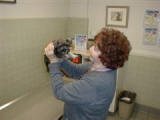
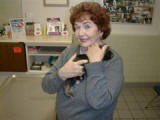
Positive restraint for puppies 4 months old and
younger
- A gentle short
hug is an extension of the
gentle, loving massage and body
manipulations.
- Hug your dog a
little longer each time. If the
dog becomes upset and struggles,
you lose points. A little
struggle is fine but the puppy should NOT panic.
- Once the dog
can be hugged easily, try
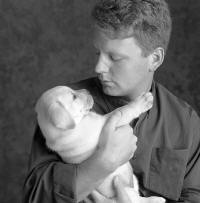
cradling the pup like a baby.
- For some pups, hugs
may need to be done daily and
extended very gradually. It is best to start all gentling
exercises with puppies at 2
month of age.
- Praise the dog for
acceptance of any restraint.
- The SECOND the dog begins to
relax, let the dog up.
When you give back his or her
freedom with praise and a
cookie, you show the dog that
you are NOT trying to hurt the
dog, you are trustworthy. Your
puppy also learns to be cooperative.
Learn more....Gentling
to Build Trust
 Print
Print Improving Relationships
between People and Pets!
Improving Relationships
between People and Pets!