|
|
Dog Behavior Library
|

Puppy Play Nipping & Biting
All
puppies love to play!
They often tell us this
by coming up and
performing a play bow. A
play bow gesture is
exhibited as the rear in
the air, tail wagging,
and paws and head
lowered to the ground.
Exuberant puppies often
give a
playful nip
to us instead just like
they would their
littermates.
Especially if we ignored
the play bow. These
puppies are just
soliciting or asking for
playtime.
If
there are other dogs in
the house this request
to play is fine between
them. However,
If
this
request to play with
humans includes a nip,
our
first response should be
to
not play.
It is
important we learn to
communicate with our
pets in a way they
understand. We do this
by understanding the
motivations behind their
behaviors. This request
for play, so an adequate
"punishment" is to
withhold play for the
inappropriate behavior.
If you do
play after they nip or
bite,
you are teaching the pup it is
not only okay to bite you, but
it is a good way to get your
attention. I f
the pup tries again turn
your back or move away. If you
begin this pattern early,
nipping
is easy to correct. If this has
been developed into a habit, it
gets harder and harder to
correct.
Inconsistency is one of
the most common mistakes
we encounter. Every
person this puppy
interacts with has to
ignore the solicitation
to play with a nip. When
some people allow it or
when you occasionally
allow the nip the pup
may perceive this as an
indication they did not
nip often enough or hard
enough. This encourages
the pup to bite harder
and more often and make
it more time consuming
to correct this
inappropriate behavior.
Puppy
Excited Biting
Puppies need lots of
play time, exercise,
physical stimulation and
sleep. 17 hours of sleep
on average! When any of
these needs are not met
they are more likely to
get "wound up". We've
all seen it. The pup who
was playing just fine
for a few minutes and
then suddenly is playing
very rough, biting or
running circles around
you or the house and
lunging with teeth
bared. It is a game
where they have become
out of control. This
play is hard to
interrupt. They will
play with their
littermates like this
and if they get to rough
their littermates will
yelp and will stop
playing with them. If
their are other dogs in
the house who can safely
play with the pup they
can help to teach them.
The pup learns not to
play out of control and
how to control the
intensity of their play.
You should be able to
call a pet's name and it
stop whatever it is
doing. This includes
play with you or others,
running after a rabbit,
chasing the cat, or
fighting with the
neighbor's dog.
So How do we Respond?
In the
end we want to teach the pup
any teeth on human skin
past a gentle touch
makes everything good
stop. Read the article
about Play Mouthing and
Bite Inhibition to teach
gentle mouthing. When
the puppy reaches
excitatory stage they
are beyond the point
where they can learn in
this heat of the moment.
They are to wound up and
we must change our
tacticts until they
learn bite inhibition.
Also, use
this method when there
are children involved in
the play.
In
this frantic moment we
must remain calm, stop
all play and mark the stop with a
verbal cue that will
eventually be all that
is needed to interrupt
the behavior.
Best Option
-
Stop play and mark
the with a verbal
"awe" in a
disappointed quiet
tone.
-
At the same time
cross your arms and
put your fists near
your arm pits to
remove your hands
from your puppy.
-
If you are not
already standing and
the pup continues
biting at you, stand
and turn your face
and body away from
the pup. If the pup
was in your lap set
them on the floor as
you do this.
-
Hold this frozen
posture, slowly and
silently count to 3
before resuming
interaction. If the
pup has settled play
again.
-
Repeat this every
time the pup gets
overly excited.
-
If the pup is with
children when this
occurs it may be
necessary to pick
the pup up for a few
seconds or hold on
to a collar, or
remove the pup to a
time-out. Time outs
should not last more
than 5 minutes.
Start Bite Inhibition
Training during a time
of day the pup is more
calm. Such as after a
play time outside or a
walk on a leash. Until
the pup learns Bite
Inhibition decrease the
intensity and duration
of play sessions.
Counter
Conditioning
Teach a behavior that
is incompatible with
biting such as licking.
If you or the children
don't mind being licked
this allows your pup to
use it's mouth without
hurting anyone. Your pup
can't lick and bite at
the same time!
Teach Kiss Me
- Place a treat in
hand.
- Ball up your
hand to a fist.
- Offer your fist
to the pup to sniff.
When he licks your
fist, say "Kiss Me"
or the verbal cue
you prefer and
reward your pup.
- If you want your
pup to kiss you 4
times begin waiting
until the fourth
lick to receive the
treat.
- If the pup
doesn't lick hold
the treat between
your index finger
and thumb with a bit
peaking out.
- If you want the
dog to lick your
face, place your
face close to your
hand and use the
same verbal cue.
Now when the pup
starts to play to rough
with the children change
the game and get out the
treats and play Kiss Me!
Games to play
with Children
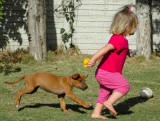
- Freeze -
Child
dances or runs 2-3
steps and stops,
when the pup also
suddenly freezes it
gets a treat. If the
pup doesn't also
freeze try another
time. The next time
decrease the
intensity of the
child's movement.
This is teaching the
pup when the child
stops it also stops
what it is doing.
After 12 successes
increase the amount
of time the child
dances or take a few
more quick steps.
When the pup fails
back up to the
beginning and start
over. Gradually
build up length of
crazy fun and
running. After you
are confident the
pup is doing this
well begin to
increase the
duration of time of
the freeze before
the pup receives the
treat.
Other Options
- Use your pup's
stuffed toys to
redirect the biting.
Often children can
use a large stuffed
toy to toss and play
gentle tug with the
pup. The pup learns
toys are for playing
with not hands and
body of the child.
Be sure to teach
Proper Chew Training
and Fetch!
- Give a time out
for 3-5 minutes
until your pup calms
down. Begin calm
play, preferable
with a stuffed toy
when or playing
fetch when he gets
out.
The Stubborn
Ones
- Use a leash to
restrain your pup
while it plays with
someone else (a
child). You control
how close the dog
gets to the other
person.
- Tether the pup
to a door knob or
heavy piece of
furniture and stand
just near enough to
reach your pup's
head to teach Bite
Inhibition or to
play. Puppy can't
reach or follow youi
in this instance
giving you more
control. Repeat the
steps from the best
option while the pup
is tethered. Read up
on Umbilical and
Close Tethering.
- As a last resort
place Bitter Apple
on clothing. It is
not recommended for
hands because we
want to maintain
positive
associations with
hands. Hands should
always be seen as
good. Just not
things to chew!
Things to
Avoid
-
Verbal reprimands. A
loud No may excite
your dog more. We
are seeking to lower
arousal.
-
Physical reprimands.
Pushing away with
your hands is
interpreted as more
play. Anything
causing discomfort
or pain will cause
fear and dis-trust
in your pup which
must be avoided.
-
If these
techniques are not working,
stop and consult a
behaviorist.
|
|
|