If
you have a dog, you naturally
want to enjoy his company. You
probably expect him to be a
calm, obedient and friendly
member of your family. However,
your dog
might exhibit behaviors that signal
his tendency
to control
you, rather than follow
your wishes. It is recommended
you employ a professional animal
behaviorist to help with this
concern.
If
you have a dog, you naturally
want to enjoy his company. You
probably expect him to be a
calm, obedient and friendly
member of your family. However,
your dog
might exhibit behaviors that signal
his tendency
to control
you, rather than follow
your wishes. It is recommended
you employ a professional animal
behaviorist to help with this
concern.
|
The
leader controls
the valued resources such as
food, freedom, touch, beds,
etc. Remind the dog on
a daily basis that
the
humans
make the
decisions. Do
not give resources for free.
Teach your dog to "say
please" by following basic
Instructions. |
Symptoms
Of Canine
Control Related Aggression
In
the wild, dogs run in groups.
Each group is a well-structured
hierarchy of
status. Every
group member knows
his or her position, and clearly
recognizes leadership. This
leadership can switch from one
dog to another depending on
the situation, but there is
usually one that is the overall
leader. This overall group leader
is called "Alpha,"
and is usually a large male,
but the leader might be a small
female with a
controlling personality.
There
are a few cases of Control or
Status Related Aggression cases
seen every year. It is actually
VERY RARE. Most aggression is
fear or conflict related. There
are rare cases where your dog views you
and your family as members of
his group.
This dog has a tendency to
try to
control
everything, his natural canine
response
will be to threaten
you
when you do not submit control
over resources or if you try to
move him. That is, if he
believes he is the leader, and
you perform any act he thinks
challenges him.
Ths dog will act
aggressively in order to "put
you in your place." The essence of these
rights is controlling resources
such as food, freedom, petting,
praise, touch, toys, etc. Controlling
these resources gives leadership.
Therefore, people in the family
should gain
control
over valuables, we
call these
Leadership Exercises.
This dog
may also often get up to block
your path of travel to control
where you go.
There
are many behaviors dogs may
exhibit to demonstrate that
they do NOT see you as the leader
of the group. Although these
behaviors tend to be more common
in unneutered males, females
as well as neutered males can
use them as well.
Are
you really in charge? Have you
seen any of these behaviors
in your pet?
-
Won't
come when called (even though
the dog understands the Instruction).
-
Won't sit or down or roll
over when Instructed (these
are submissive positions).
-
Moves to
block your path,
forcing you to walk around
him, instead of moving out
of your way.
-
Muzzles your hand, insisting
that you pet him (a canine ordering you to obey
him).
-
Will not let you: give medications,
catch fleas, groom or otherwise
handle him.
-
Gets up on furniture without
permission, and won't
get down.
-
Defends food bowl or other
objects from you.
-
Stares you in the eye, lowers
the head or assumes a frozen
threat posture.
-
Growls at you, under any circumstance.
-
Snaps
at you but not connect his
teeth with your skin or clothing.
-
Grabs your hand when agitated,
then release it without causing
pain.
Pay
special attention to more aggressive
signs; these include
growling, snapping or grabbing
your hand in his mouth (even
if he does not bite hard).
Don't be
fooled though many of these are
also just signs of a bratty dog
that has been allowed to do all
these things by the owner.
|
Signs of aggressive threats
in canine body language are
a frozen posture, fixed stare,
hair bristled with ears and
tail up. |
Submissive canine behavior,
on the other hand, is demonstrated
by eyes, ears and tail down,
crouching or rolling over. Showing
his tongue is often a subtle
sign of subordination.
If you see any of these
behaviors your dog does NOT have
control related aggression.
Steps
For Treatment
Avoid Aggression Risk
Situations
First,
analyze what situations caused
tense behavior in the dog. Temporarily
avoid those situations. Once
the relationship is reversed,
and the dog clearly recognizes
you as his leader, carefully
approach those situations. Follow
the "Leadership Exercises"
below.
Employ
A Behaviorist Qualified To Deal
With Canine Aggression.
If
your dog has already connected
with a bite that broke human
skin, an obedience class is
not enough. Instead, after the
medical workup, ask your vet
for a referral to an experienced
behaviorist to help you restructure
your relationship with your
dog.
Rule
Out A Medical Cause
There
are genetic and physiologic
conditions which can contribute
to canine aggression. We must
not
overlook the possibility that
your pet may have a serious
disease condition such as hypothyroidism,
epilepsy, hydrocephalus or metabolic
dementia that can cause aggressive
behavior. Even minor conditions
such as fleas, dental pain, or
a bladder infection can contribute
to frustration based aggression.
Have
your veterinarian give your
dog a thorough medical evaluation.
This workup will likely include
a good physical exam to rule
out pain-induced aggression,
blood, urine and fecal tests,
and possibly X-Rays looking
for other internal causes of
stress, pain or frustration.
Any
dog with
controlling tendencies
should be neutered. This will
help eliminate hormonal influences.
Dogs will still defend property
and people after neutering.
Although they may be great companions,
it is recommended that dogs
exhibiting this symptoms not
be bred.
That is, the
dog mistakenly thinks he is
in charge of the group because
"his humans" unintentionally
communicate to the dog that
he is in charge.
CAREFULLY
Begin
"Leadership Exercises"
Ironically,
the things that signal
giving up
control to the dog are things
we
do to show the pet we care and consider him a member
of our family. We sometimes
give food if he begs; he may
view this as giving him (the
leader) the best food. We groom
(pet) him; subordinate dogs
groom (lick) their leader. We
follow the dog through doors,
and let him strain on the leash
or run ahead (lead) on walks.
In the house, we walk around
the dog where it lies, and we
oblige virtually any request
(order) he makes of us.
Before
feeding your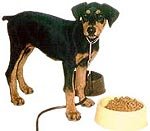 dog, request
a
sit or down. Make him earn
the right to eat. You should
do this by making your dog sit
or remain in a "down stay"
position for a period of time,
which you lengthen daily. Once
the dog obeys your Instruction to
your satisfaction, give him
the food. Remove the bowl as
soon as he has finished eating.
Begin to make him "earn"
(by sitting) praise, attention,
play, and walks.
dog, request
a
sit or down. Make him earn
the right to eat. You should
do this by making your dog sit
or remain in a "down stay"
position for a period of time,
which you lengthen daily. Once
the dog obeys your Instruction to
your satisfaction, give him
the food. Remove the bowl as
soon as he has finished eating.
Begin to make him "earn"
(by sitting) praise, attention,
play, and walks.
Finally, your pet will learn
that you control everything he
values.
Change
The Rules
If
the dog has been allowed up
on the bed or furniture, change
the rule (which as leader, you
can do anytime you want!) By
being on the same level off
the floor, the dog is establishing
equality or leadership over
you. At night, crate the dog
or tether it on a 2-3 foot lead
at the foot of the bed.
|
If he doesn't follow
Instructions he knows, don't
force him to obey. However,
withhold the reward. Instead
give the "cold shoulder"
(ignore the dog), then try
again a few minutes later. |
Restrict
The Dog's Movements
Do
not allow a
controlling dog to sleep
in your bed, or to get up on
furniture. The best
way to get the dog the bed or
furniture is to say COME. Then,
attract him off with a tasty
food treat. Don't use
your hands to push the dog off
the bed, because he may bite
you. If you can safely attach
a leash, tie him to the food
of the bed, or put him in a
room far away from the bedroom.
He loses the privilege of sleeping
on the bed or furniture until
he will follow simple requests
like OFF, and immediately jump
off the bed.
Another
way take away freedom and lower
status is through use of a tether.
When home, use a leash or a
cord to tie the dog to your
chair or your ankle if seated,
or around your waist if moving
around. This means the dog has
no choice but to follow you
as long as the cord is in use.
During this time you should
reward every relaxed posture
the dog displays with praise
and treats..jpg)
Use
"Time Out"
If
the dog acts inappropriately,
try using a time-out.
Either simply ignore him, isolate
him in a separate room, or tie
him to a solid object for 5-10
minutes. When releasing the
dog, insist on a
deference
posture such as sit or down
before releasing him.
Does
your dog demand attention when
you come home by barking, jumping,
etc.? Whenever this happens,
ignore him. Once he calms down,
Instruction him to sit. Don't
greet him until he obeys the
Instruction.
This will reinforce you as the
leader, because you are controlling
the valued resource of the greeting.
|
To a dog, restricting
freedom of movement lowers
status. Close
tethering, kenneling, and
"time outs" can be used to
restrict freedom and
lower status. |
"Trade
Up"
If
you need to take something away
from a
pushy dog, "trade
up". This means find something
that would be even more desirable
(e.g. small piece of meat) and
offer that. Make the dog sit
or down, remove the other object,
then give the food and praise
the submissive position.
Lead
Lead
the dog whenever possible. When
on walks, keep the dog near
you (heeling), and change directions
frequently to display you are
in charge and not the dog. When
going through doorways, insist
on going through first, using
the leash to hold the dog back.
(Make the dog sit and wait,
then release it.)
Get
a head collar such as the "Gentle
Leader™" system.
Insist the dog wear it as long
as there is ambiguity about
leadership. This head halter
sends a subtle calming signal
to the dog.
Model
And Praise Calm Canine Behavior
If
there is a tense moment in any
situation, avoid acting tense
yourself. Try to act "Jolly"
to reduce any tension in the
situation. Realize that YOUR
tension may be picked up by
the dog. Even if you feel tense,
act relaxed or jolly.
Look
for any situation in which the
dog is lying quietly, or acting
calm. Praise the dog saying,
"Good Settle." The
goal will be to eventually use
"Settle" as a Instruction
to induce the dog to act calmly.
Obedience
School
Enroll
in an obedience class, even
if you have been through one
before. The frequent Instructions
and well-timed collar corrections
reinforce you as leader. It
is recommended that a Head Halter
be introduced at the time of
obedience training (or sooner
if possible). The trainer will
likely be able to help you through
the first few moments of the
dogs reaction to the head collar.
Once they adapt, the dog can
wear the head halter on walks,
at obedience class, and even
inside the house when you want
additional control.
If
You Feel Threatened
If
there are any really tense
moments while you are trying
to displace your dog as leader
of the group, back off casually,
since you could get hurt. Ask
your vet for a referral to a
behaviorist. In the meantime,
avoid the situation that caused
the tension, and try to stay
happy and act jolly. This should
remove the tenseness of the
situation. Remember, if the
dog acts aggressively, back
off, then give the dog
the "cold shoulder"
(totally ignore). Then, avoid
the situation that resulted
in the aggressive behavior until
you have reinstated your leadership
role.
Until the problem is solved or
you see the behaviorist, insist
that your dog perform Instructions
to earn food and attention. The
price for not correcting this
problem is likely to be your
pet's life! Dogs who are
dangerous to people are often
"put down."
|
If your pet tries to
control you or
anyone you know, the key to
preventing euthanasia due to
status
aggression is
to seek professional help
early, without
resorting to violence.
|
Once a dog has seriously
bitten a human, and got what
he wanted as a result, he has
learned that he can
control
the people around him by being
aggressive. It
is very difficult to ever be
confident that this dog will
never bite again.
Anytime
the dog is so aggressive that
he may attack and harm people,
it's time to call an experienced
dog behaviorist. Still, some
cases end in failure to correct
this habit. That is, the dog
must be euthanized (lethal injection).
There's
a rule of thumb in behavior
modification:
"Don't
Treat Aggression With Aggression
- It Causes More Aggression."