Usually,
it is a big deal for a dog to
meet another dog. The only exception
is when a dog has been raised
meeting new dogs commonly, so
that it becomes routine. The
next best scenario is dogs that
go through a socialization puppy
class where they are allowed
to wrestle and have full contact
play. Preschool is where they
learn proper manners (e.g. you
don't jump on dogs bigger
than you, unless given permission).
Even dogs who have been through
puppy preschool (2-5 months
of age) need regular exercise
meeting new dogs throughout
the few years of life. An important
period to meet new dogs (e.g.
at daycare or the dog park)
is between 1 and 3 years of
age, since dogs develop emotional
maturity by about 3 years old.
If the dog is very experienced
by this age, he will usually
be dog-friendly for life unless
some bad experience, or the
owners unintentionally allow
the dog to become
controlling.
|
Even
dogs who have been through
puppy preschool (2-5 months
of age) need regular exercise
meeting new dogs throughout
the few years of life. |
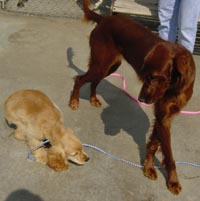
 Dogs
who meet other dogs easily develop
an outgoing friendly personality
that allows them to make friends
for life, play for hours, and
get lots of exercise. (Sounds
pretty good for people too!)
Dogs
who meet other dogs easily develop
an outgoing friendly personality
that allows them to make friends
for life, play for hours, and
get lots of exercise. (Sounds
pretty good for people too!)
Meeting
When Both Dogs Are On Leash
While Out Walking
Proper
dog etiquette is to ask the
other owner if their dog is
friendly with other dogs. They
will usually know. If they say
"yes", then ask
if it is OK for the dogs to
meet. If "yes" again,
here is the secret: you greet
the other dog first with a high
happy voice, and relaxed body
language. In this situation,
you are acting as a leader,
and showing your dog what you
want. Move your dog behind you
or step on the leash while you
get low (don't loom over
the other dog; it is a threat.)
Offer your hand, while looking
off to the side and let the
strange dog make the first touch.
This shows trust on the dog's
part, by approaching you. If
the dog freezes, it is showing
you a threat; either stay there
for a while, act relaxed and
wait, or just back off and move
on.
Your
dog will likely be very interested
and want to sniff, but only
allow this if you sense a friendly
attitude. Allow them to sniff,
but continue to talk in a high
happy voice, and praise your
dog for friendly behavior. Beware
of leash entanglement. If they
begin to spin, pull your dog
away and start over. Just when
you pull your dog away is the
most likely time they will get
aggressive. Do it quickly and
unexpectedly, so your dog doesn't
have time to snap. If your dog
does part friendly, the reward
is another immediate visit to
the same dog before moving on.
Continue keeping the leashes
untangled. Remember to act relaxed
(even if you're not) and
praise friendly behavior. They
only way your dog will learn
is by experience with your guidance.
If your dog has been aggressive
in the past, have your dog wear
a muzzle for the safety and
show your dog attacks don't
work.
The
ideal signal from either dog
is a play bow (front legs slap
ground, with rump up.) This
signals no threat, and a friendly
invitation to play. If either
dog does this behavior, praise
it profusely.
Meeting
When Both Dogs Are Off Leash
As
soon as you see the other dog,
call your dog to you and put
him on a leash. If it is too
late, and you can see your dog
is going to the other, start
infusing the situation with
high happy talk and encouragement
to get along. Give your attention
and praise to the OTHER dog.
Call him to you if he seems
friendly. Try to make friends
with that dog while your dog
watches and hopefully follows
your lead. When you see the
chance, get your dog on leash
and leave since you cannot control
the situation.
Meeting
When Your Dog Is On A Leash
And The Other Dog Isn't
In
this case, just keep on moving
and don't take a chance
since there is no one to even
try to control or influence
the other dog. If the dog is
very friendly, you may wish
to stop and say hi.
Meeting
When Your Dog Is Off Leash,
And The Other Dog Is On Leash
This
is a great opportunity to practice
your COME Instruction. If your dog
does not come to you under this
situation, you should not let
your dog off leash again until
you have worked on COME. The
way to do this is to use a long
leash, and repeatedly call the
dog, give short tugs if necessary,
then treat and praise compliance.
Finally let him off leash when
COME is reliable, but initially
have him drag it. Call him every
few seconds. If he comes, he
gets a longer time off leash.
If he doesn't come immediately
when called, run after him and
step on the leash then start
working on COME again.