Why
do dogs need to be confined?
Dogs
are highly social animals that
make wonderful pets. They can
be effective as watchdogs, are
excellent companions for play
and exercise, and are sources
of affection and comfort. However,
with the lifestyle and schedule
of the majority of families,
dogs must learn to spend a portion
of the day at home, while their
human family is away at school,
work, shopping or recreational
activities. During those times
when you are away and unavailable
to supervise,
the pet may still feel the need
to chew, play, explore, eat,
or eliminate.
 How
can this misbehavior be prevented? How
can this misbehavior be prevented?
Preventing
such inappropriate behaviors
when you are absent involves
both scheduling and prevention.
Scheduling means insuring that
the pet has had the opportunity
to play, eat, and eliminate
before you leave it in its confinement
area or kennel. Prevention involves
keeping the pet in a confined
area where it is secure, safe,
and can do no damage to itself
or your possessions.
What
are my options for confinement?
Depending
on the structure of your home,
it may be possible to dog-proof
the house by closing a few doors,
or putting up some child gates
or barricades. The dog can then
be allowed access to the remaining
areas of the house. Another
option is to use avoidance devices
that keep the pet away from
selected areas using motion
detectors, citronella spray
collars or other forms of "booby-traps"
(see our handout on ‘Behavior
management products').
If this dog-proofing is not
possible when you have to leave,
confine the dog to a single
room, pen, or kennel. This smaller
confinement area not only provides
safety for the dog and protection
of the home from damage, but
also provides a means of teaching
the dog what it is supposed
to chew, and where it is supposed
to eliminate.
Isn't
kennel training cruel?
Kennel
training is neither cruel nor
unfair. On the contrary, leaving
the dog unsupervised to wander,
investigate, destroy, and perhaps
injure itself is far more inhumane
than confinement. Ensure that
the kennel is large enough so
the dog gets sufficient food,
play, exercise and attention
before it is confined, and you
return before the dog needs
to urinate or defecate.
What
are the benefits of kennel training?
The
two most important benefits
are the safety it affords the
pet, and the damage that is
prevented. The cage also provides
a place of security; a comfortable
retreat where the dog can relax,
sleep, or chew on a favorite
toy. Behavior problems can be
immediately prevented by confining
the pet to a kennel or room,
when the owner is not available
to supervise. When you are at
home, supervision and rewards
can be used to prevent undesirable
behavior, and to teach the dog
where to eliminate, what to
chew, and what rooms and areas
are "out of bounds."
Will
cage confinement help with house-training?
Yes.
Kennel training is one of the
quickest and most effective
ways to house-train a dog. Since
most dogs instinctively avoid
eliminating in their sleeping
and eating areas, dogs that
use their kennel as a bed or
"den" will seldom
eliminate inside unless they
have been left in the kennel
for too long. Kennel training
can also help teach the dog
to develop control over its
elimination (see our handout
on ‘Puppy – getting
started and house training guide').
As
soon as your dog is released
from its kennel, take it to
the designated area and reward
elimination at acceptable locations.
Since the kennel prevents chewing,
digging, and elimination on
the owner's home and property,
owners of kennel trained puppies
have fewer behavior concerns,
the puppy receives far less
discipline and punishment, and
the overall relationship between
pet and owner can be dramatically
improved.
Will
the kennel provoke barking?
No.
The kennel can also be a useful
way to reduce or eliminate distress
barking. Rather than locking
the puppy up and away from the
owners at night time or during
mealtime, the puppy can be housed
in its kennel in the bedroom
or kitchen. In this way the
puppy cannot get into mischief,
and is less likely to cry out
or vocalize, if the owners are
in the room. If the puppy is
locked away in a laundry room
or basement with no access to
the owners, distress vocalization
is far more likely. If the owner
then goes to the puppy to quiet
it down or check it out, the
crying behavior is rewarded.
What
about caging and travel?
Of
course, throughout its life,
whether traveling or boarding,
the dog may require kennel confinement.
Those dogs that are familiar
and comfortable with caging
are more likely to feel secure,
and far less stressed, should
caging be required.
PUPPY
KENNEL TRAINING
What
type of kennel or confinement
area works best?
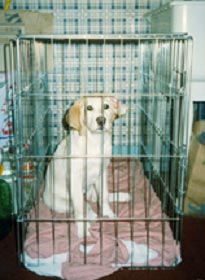
A
metal, collapsible kennel with
a tray floor works well, as
long as the kennel is large
enough for the dog to stand,
turn, and stretch out. Some
dogs feel more secure if a blanket
is draped over the kennel. A
plastic traveling kennel or
a homemade kennel can also be
used. Playpens or barricades
may also be successful as long
as they are indestructible and
escape proof.
Where
should the cage be located?
Because
dogs are social animals, an
ideal location for the kennel
is a room where the family spends
time such as a kitchen, den,
or bedroom rather than an isolated
laundry or furnace room.
How
can crating or confinement become
a positive experience?
Most
dogs quickly choose a small
area, such as a corner of a
room, in a dog bed, or on or
under a couch, where they go
to relax. The key to making
the kennel the dog's favorite
retreat and sleeping area, is
to associate the kennel with
as many positive and relaxing
experiences and stimuli as possible
(food, treats, chew toys, bedding)
and to place the dog in its
cage only at scheduled rest
and sleep periods. You must
therefore be aware of the dog's
schedule, including its needs
for exploration, play, food,
and elimination, so that the
dog is only placed in its cage,
when each of these needs is
fulfilled. You must then return
to the dog to release it from
its cage before the next exercise,
feeding or elimination period
is due.
A
radio or television playing
in the background may help to
calm the dog when it is alone
in its cage, especially during
the daytime. These may also
help to mask environmental noises
that can stimulate the dog to
vocalize.
The
kennel should never be used
as punishment.
How
do I kennel-train my new puppy?
1)
Introduce the puppy to the kennel
as soon as it is brought home
and as early in the day as possible.
Place a variety of treats in
the cage throughout the day
so that the puppy is encouraged
to enter voluntarily. Food,
water, toys and bedding could
also be offered to the puppy
in the open cage.
2)
Choose a location outdoors for
the puppy to eliminate. Take
the puppy to the location, wait
until the puppy eliminates,
and reward the puppy lavishly
with praise or food. After some
additional play and exercise,
place the puppy in its kennel
with water, a toy and a treat
and close the door.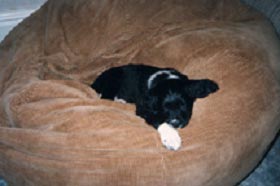
3)
If the puppy is tired and calm,
it may take a "nap"
shortly after being placed in
its kennel.
4)
Leave the room but remain close
enough to hear the puppy. Escape
behavior and vocalization are
to be expected when a dog is
first placed into its kennel.
If the "complaints"
are short or mild, ignore your
puppy until the crying stops.
Never release the puppy unless
it is quiet. This teaches that
quiet behavior, and not crying
will be rewarded. Release the
puppy after a few minutes of
quiet or a short nap.
5)
Punishment may be useful to
deter crying if it does not
subside on its own. A shaker
can (a sealed can filled with
coins or marbles) can be tossed
at the kennel when the pup barks.
Other methods include water
sprayers or alarms (audible
or ultrasonic). The owner should
remain out of sight. By plugging
in an alarm, tape recorder,
water pik, or hair dryer beside
the kennel and turning it on
with a remote control switch
each time the dog barks, the
dog can be taught that barking
leads to punishment whether
the owner is present or not.
When the barking ceases, the
punishment is stopped. Bark
collars and alarms or water
sprayers that are activated
by the barking are also available
for persistent problems. Punishment
must always be used with caution,
since it can exacerbate the
vocalization problem of a very
anxious pet.
6)
Repeat the cage and release
procedure a few more times during
the day before bedtime. Place
the puppy in its kennel a few
times before the end of the
day. Each time, increase the
time that the dog must stay
in the kennel before letting
it out. Always give the puppy
exercise and a chance to eliminate
before locking it in the kennel.
7)
At bedtime, the dog should be
exercised, locked in its kennel,
and left for the night. Do not
go to the dog if it cries. Remote
punishment can be used to deter
crying. Alternately, the kennel
can be kept in the bedroom.
8)
If the pup sleeps in one end
of its kennel and eliminates
in the other, a divider can
be installed to keep the puppy
in a smaller area.
9)
Never leave the puppy in its
kennel for longer than it can
control itself or it may be
forced to eliminate in the kennel.
10)
If the pup must be left for
long periods during which it
might eliminate, it should be
confined to a larger area such
as a dog-proof room or pen,
with paper left down for elimination.
As the puppy gets older, its
control increases and it can
be left longer in its kennel.
11)
Although there is a great deal
of individual variability, many
puppies can control themselves
through the night by 3 months
of age. During the daytime,
once the puppy has relieved
itself, a 2-month old puppy
may have up to 3 hours control,
a 3-month puppy up to 4 hours,
and a 4 month old puppy up to
5 hours.
12)
A kennel is not an excuse to
ignore the dog!
KENNEL TRAINING ADULT DOGS
What
is the best technique for kennel
training older pets and adult
dogs?
1)
For adult dogs or older puppies
that have not been kennel trained
previously, set up the kennel
in the dog's feeding area with
the door open for a few days.
Place food, treats, and water
in the kennel so that the dog
enters the kennel on its own.
Another alternative is to place
the kennel in the dog's sleeping
area with its bedding. Once
the dog is entering the kennel
freely, it is time to close
the door.
2)
Using the same training techniques
as for ‘sit' and
‘stay' training,
have the dog enter its kennel
for short periods of time to
obtain food, treats, or chew
toys. Once the pet expects treats
each time it enters the kennel,
train the dog to enter the kennel
on command (e.g. kennel!), and
have the dog remain in the kennel
for progressively longer periods
of time, before the dog is allowed
to exit. Give small rewards
each time the dog enters the
cage at first, and give the
dog a favored chew toy or some
food to help make the stay more
enjoyable. At first, the door
can remain open during these
training sessions.
3)
When the dog is capable of staying
comfortably and quietly in the
kennel begin to lock the dog
in the kennel at nighttime.
Once the dog sleeps in the kennel
through the night, try leaving
the pet in the kennel during
the daytime. Try short departures
first, and gradually make them
longer.
Is kennel training
practical for all dogs?
An
occasional dog may not tolerate
kennel training, and may continue
to show anxiety, or even eliminate
when confined. These dogs may
adapt better to other types
of confinement such as a pen,
dog run, small room, or barricaded
area. Of course, if the dog
is being left alone for longer
than it can control (hold in)
its elimination, it will be
necessary to provide an area
much larger than a cage, so
that the pet has a location
on which to eliminate, away
from its food and bedding.
Continued
anxiety, destruction or vocalization
when placed in the kennel may
indicate separation anxiety.
The intervention of a behaviorist
may be needed.
This
client information sheet is
based on material written by
Debra Horwitz, DVM, DACVB and
Gary Landsberg, DVM, DACVB.
© Copyright 2002 Lifelearn
Inc. Used with permission under
license. March 11, 2004. |