Why
do dogs dig?
Digging
behavior in dogs can have many
motivations. Some breeds, such
as the Northern breeds (Huskies,
Malamutes) dig cooling holes
and lie in them. On a very hot
summer day any dog may dig a
hole to cool off. Breeds such
as the terriers have been bred
to flush out prey or dig for
rodents.  With
their ability to hear high frequency
sounds, and their highly acute
sense of smell, some dogs dig
as a direct result of odors
or sounds such as voles and
moles that attract the pet from
beneath the ground. Pregnant
bitches dig when nesting. Dogs
dig to bury or retrieve bones.
Dogs also dig to escape from
confinement. Digging may also
be an activity similar to destructive
chewing that occurs when pets
are left alone with insufficient
stimulation or attention. This
is particularly so in puppies
and in highly energetic dogs. With
their ability to hear high frequency
sounds, and their highly acute
sense of smell, some dogs dig
as a direct result of odors
or sounds such as voles and
moles that attract the pet from
beneath the ground. Pregnant
bitches dig when nesting. Dogs
dig to bury or retrieve bones.
Dogs also dig to escape from
confinement. Digging may also
be an activity similar to destructive
chewing that occurs when pets
are left alone with insufficient
stimulation or attention. This
is particularly so in puppies
and in highly energetic dogs.
How
can I determine why my dog is
digging?
The
first step in treating inappropriate
digging behavior is to determine
the reason for digging. Prevention,
remote punishment, and booby-traps
may also be needed, but reducing
your dog's motivation
to dig, and providing for all
of its needs are essential so
that digging is not merely redirected
to a new location. Inhibiting
or preventing all digging, without
understanding and dealing with
the dog's motivation could
result in new behavior problems
such as chewing, excessive vocalization,
or escape behaviors.
Dogs
that dig because they are pursuing
prey will continue unless you
can get rid of the prey. Dogs
that dig in an attempt to get
cool should be provided with
a cool resting area with plenty
of shade and water. On very
hot days, it may be best to
bring your dog inside.
One
of the most common reasons for
digging is as a form of play,
activity and exploration. Additional
play, training and exercise
sessions may be needed to keep
digging behaviors under control,
especially if your dog is young
and very active. Dogs that continue
to dig may require additional
stimulation to keep them occupied
when the owners are not around.
Treatment for this type of digging
can be found in our puppy handout
on ‘Destructiveness –
chewing'. If your dog
is outside all day and digging
is taking place, you do need
to ask yourself if keeping the
dog inside may be a better answer.
This is particularly true for
the dog that digs to escape
from the yard or confinement
area. If you are unable to keep
the dog inside because of house-soiling,
destruction, or separation anxiety
then you may need to address
those problems first.
How
can I stop inappropriate digging?
a)
Provide a digging area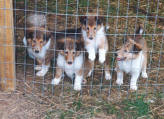
For
some dogs it may be useful for
you to create an area where
the dog is allowed to dig. This
could be a spot in the backyard
where you have placed soft dirt
and perhaps railroad ties around
the area to delineate the location.
Next, make this place somewhere
that your dog would like to
dig in. Bury things there that
your pet would like to dig up.
This might be food, lightly
covered. Then put things deeper
into the ground. If you do that
(naturally when your dog is
not watching!) at irregular
intervals, your dog should be
more likely to dig there, than
other locations in your yard.
Another option is to allow the
dog to dig in a spot where it
has already chosen, and to prevent
digging in other locations by
supervision, confinement (prevention),
or booby-traps.
b)
Supervision and punishment
Supervision
and direct intervention (shaker
can, verbal reprimand, and water
rifle) can be used to prevent
inappropriate digging in the
owner's presence but the
behavior will likely continue
in the owner's absence.
Remote punishment (turning on
a sprinkler, pulling on an extended
leash, a remote collar), booby-traps
(placing chicken wire, rocks
or water in the area where the
pet digs), or covering the surface
with one that is impervious
(asphalt/patio stones) might
teach the pet to avoid the digging
site even in the owner's
absence. These techniques do
not however prevent the pet
from digging in other locations.
What
else can be done if inappropriate
digging continues when I am
not around to supervise?
When
you are unavailable to supervise
your dog, housing the dog indoors
is the most practical solution
until he or she has learned
to stay outdoors without digging.
If you would like to continue
to leave it outdoors, it is
best to confine the dog to an
area such as a pen or run, so
that it has no access to the
digging areas. The run should
be inescapable, and could be
covered with gravel, patio tiles
or have an asphalt or concrete
floor so that it cannot escape
or do damage. Of course it will
be necessary to provide sufficient
exercise and stimulation before
confining the dog and an adequate
number of treats and play toys
in the run to keep the dog occupied.
Another alternative is to provide
an area within the pen or run
where digging is allowed.
This client
information sheet is based on
material written by Debra Horwitz,
DVM, DACVB and
Gary Landsberg, DVM, DACVB.
© Copyright 2002 Lifelearn
Inc. Used with permission under
license. March 11, 2004. |