|
Why
is my dog aggressive towards
other dogs?
Aggression
between dogs can result in injury
to dogs and/or to the people
trying to separate them. The
behavior can consist of growling,
snarling, barking, lunging,
snapping and biting.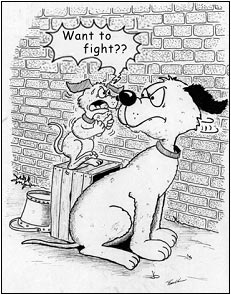
Why
would my dog fight with dogs
he has never met?
Aggression
between unfamiliar dogs can
be due to dominance, fear, or
protective behavior over territory
or owner.
Dominance motivated aggression
This
aggression can be elicited by
dominant gestures or postures
from either dog. These can include
placing head or feet, on the
back of the other dog, dominant
body postures such as eye contact,
and high tail and stiff legged
approach. Owners may inadvertently
reinforce the behavior by leash
tightening and vocal cues. These
may signal to the dog that the
impending approach is problematic.
Unfortunately leash restriction
does not allow the dog to react
with a complete rate and range
of responses including body
postures, approach and withdrawal.
Additionally, this behavior
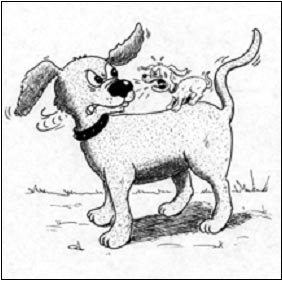
can be elicited by smaller dogs
that repeatedly "attack"
larger dogs that are attempting
to avoid interaction. Dogs of
near equal dominance and those
of the same sex are most likely
to compete for dominance. Some
extremely bold or assertive
dogs will fight rather than
back down when challenged. Although
dominance challenges may be
a source of aggression when
two dogs are meeting each other
for the first time, most dominance
hierarchies are established
with posturing and no fights.
It is likely therefore that
fear, territorial behavior and
learned components, would contribute
to an attack. Dominant aggressive
dogs may be over-assertive and/or
overprotective if the owners
do not have good control or
have taken a subordinate position
in relationship to the dog.
Territorial
aggression toward other dogs
This
aggression is primarily exhibited
when unfamiliar dogs are on
the resident dog's property,
or what the aggressor considers
his territory. Some dogs get
highly aroused at the sight
of other dogs on their territory
and may jump fences, or go through
windows or doors to get to the
intruder.
Fear
based aggression toward unfamiliar
dogs
This
aggression is very common in
aggressive encounters with other
dogs. The diagnosis is made
based on the body postures and
reaction of the dog when faced
with another dog. The fearful
dog will often have the tail
tucked, ears back and may lean
against the owner or attempt
to get behind them. They may
be barking at the approaching
dog and backing up at the same
time. Often the dog is avoiding
eye contact. This behavior can
be precipitated by previous
aggressive attacks from which
the dog could not escape and
sustained injury. Owners that
try and calm their aggressive
dog may serve to reinforce the
aggression, while those that
try and punish the dog will
only serve to heighten the dog's
fear and anxiety in relationship
to the stimulus. Good control
can help to calm the dog, while
owners who have their dogs restrained
on a leash (especially with
a choke or pinch collar) and
have poor control often have
highly defensive dogs. Dogs
that are restrained on a leash
or tied up are more likely to
display aggression when frightened,
because they cannot escape.
Learned
components of aggression
 Learning
and conditioning aggravate most
forms of inter-dog aggression.
Should threats or aggression
result in the retreat (or removal
by the owner) of the other dog,
the behavior has been successful.
If the owner tries to calm the
aggressive dog or distract it
with food treats, this may only
serve to reward the aggressive
behavior. One of the most common
mistakes is to punish the dog
that is aggressive toward other
dogs. This usually serves to
heighten the dog's arousal,
and teaches the dog that the
stimulus (other dog) is indeed
associated with unpleasant consequences.
Many owners, in an attempt to
gain more control, then increase
the level or type of punishment
(e.g. prong collars) which further
heighten the dog's arousal
and in some cases may lead to
retaliation and defensive aggression
toward the owners. And, if the
dog to dog interaction results
in pain or injury to one or
both dogs, the dogs will quickly
learn to become more fearful
and aggressive at future meetings.
In short, if the owners cannot
successfully control the dog
and resolve the situation without
heightening the dog's
anxiety or increasing its fear,
the problem will progress with
each subsequent exposure. Learning
and conditioning aggravate most
forms of inter-dog aggression.
Should threats or aggression
result in the retreat (or removal
by the owner) of the other dog,
the behavior has been successful.
If the owner tries to calm the
aggressive dog or distract it
with food treats, this may only
serve to reward the aggressive
behavior. One of the most common
mistakes is to punish the dog
that is aggressive toward other
dogs. This usually serves to
heighten the dog's arousal,
and teaches the dog that the
stimulus (other dog) is indeed
associated with unpleasant consequences.
Many owners, in an attempt to
gain more control, then increase
the level or type of punishment
(e.g. prong collars) which further
heighten the dog's arousal
and in some cases may lead to
retaliation and defensive aggression
toward the owners. And, if the
dog to dog interaction results
in pain or injury to one or
both dogs, the dogs will quickly
learn to become more fearful
and aggressive at future meetings.
In short, if the owners cannot
successfully control the dog
and resolve the situation without
heightening the dog's
anxiety or increasing its fear,
the problem will progress with
each subsequent exposure.
How
can I prevent my dog from becoming
aggressive with other dogs?
Prevention
starts with puppy training and
socialization. Early and frequent
association with other dogs
will enable your pet to learn
proper interactions and reactions
to other dogs. This can be very
helpful in prevention of aggression
to other dogs.
You
must have good control of your
dog. This means that your dog
will take contextual cues from
you, and may be calmer and less
anxious in the presence of new
stimuli. Moreover, the dog should
reliably respond to commands
to ‘sit', ‘stay'
and ‘quiet'. If
necessary, the dog may need
a head halter to give you additional
control. When in situations
where the dog may encounter
other dogs, a leash is necessary.
For
territorial behaviors, what
is most important is to prevent
the dog from engaging in prolonged
and out of control aggressive
displays both in the home and
yard. Aggressive displays include
barking, lunging, fence running,
jumping on doors, windows and
fences. These types of behaviors
should be discouraged and prevented.
One important component is teaching
your dog a ‘quiet'
command for barking (see handout
on Barking).
My
dog is already aggressive to
other dogs. What can I do?
First
and foremost, you must have
complete control over your pet.
This not only serves to calm
the dog and reduce its anxiety,
but also allows you to successfully
deal with each encounter with
other dogs. Leashes are essential
and the use of head collars
and/or muzzles are strongly
recommended for dogs that will
be in situations with multiple
dogs.
Begin
by establishing reliable responses
to basic obedience commands.
If the dog cannot be taught
to ‘sit', ‘stay',
‘come' and ‘heel',
in the absence of potential
problems, then there is no chance
that the dog will respond obediently
in problematic situations. Reward
selection can be critical in
these cases, since the dog needs
to be taught that obedient behavior in the presence of
the stimulus (other dog) can
earn the dog-favored rewards.
The goal is that the dog learns
to associate the approach of
other dogs with rewards.
behavior in the presence of
the stimulus (other dog) can
earn the dog-favored rewards.
The goal is that the dog learns
to associate the approach of
other dogs with rewards.
Long
term treatment consists of desensitization
(gradual exposure) and counter-conditioning
the dog so that the approach
of the other dogs leads to a
positive emotional response.
In training terms the dog must
be taught to display an appropriate,
acceptable response when other
dogs approach (e.g. ‘sit',
‘watch', ‘relax')
which can be reinforced (differential
reinforcement or response substitution).
This must be done slowly, beginning
with situations where the dog
can be successfully controlled
and rewarded and very slowly
progressing to more difficult
encounters and environments.
The first step is to perform
training for its favored rewards,
in a situation where there are
no dogs present and the owner
is guaranteed success. Food
or toy prompts can be used at
first, but soon the rewards
should be hidden and the dog
rewarded intermittently. The
selection of favored food or
toys is essential since the
goal is that the dog will learn
that receiving these favored
rewards is contingent on meeting
other dogs.
Once
the dog responds quickly and
is receiving rewards on an intermittent
basis, training should progress
to low-level exposure to other
dogs. If the owner's training
and the rewards are not sufficient
to control the dog in the absence
of the other dogs, then utilizing
a leash and head collar, selection
of more motivating rewards,
and seeking the assistance and
guidance of a behaviorist should
be considered. The next steps
in desensitization and counter-conditioning
rely on a stimulus gradient.
In other words your dog needs
to be controlled, (preferably
with leash and head halter)
and respond to commands and
rewards in the presence of gradually
more intense stimuli.
Begin
with a calm, and well-controlled
second dog, in an environment
where your dog is least anxious
or threatened, and at a sufficient
distance to get your dog to
respond to your commands. Gradually
the dog is exposed to dogs at
closer distances and in more
familiar locations. Using the
head halter and a prompt (reward
prompt, set of keys) it should
be possible to keep the dog
focused on the owner and sufficiently
distracted. While dogs with
fear aggression may improve
dramatically, dogs with dominance-related
aggression that are trained
in this manner usually do not
greet other dogs, but should
walk calmly with their owners
and not initiate fighting behavior.
Dogs
that are exhibiting territorial
aggression should be retrained
in much the same manner, but
the gradient of stimuli will
need to be adjusted. Begin in
the front hall or on the front
porch with no other dogs around.
Then with the dog controlled
in the hall or on the porch,
other dogs could be brought
to the perimeter of the property.
Over subsequent training sessions,
the dogs could be brought closer
to your dog, or your dog could
be moved closer to the other
dog. (See our handout on Behavior
Modification - desensitization,
counter-conditioning, differential
reinforcement and flooding).
Another
way to disrupt the undesirable
response and get the dog's
attention is to use an air horn,
shake can or citronella spray
collar. In fact, if the dog
barks prior to the aggressive
display, a citronella spray
bark collar will be activated
by the dog's barking insuring
immediate timing and disruption.
Once the inappropriate behavior
ceases, and you get your dog's
attention, the dog should be
redirected to an appropriate
behavior such as play. The greeting
should be repeated, until no
threats or aggression are observed.
Success
can be achieved in a number
of ways, but head halters are
generally the most important
tools. Head halters provide
enough physical control that
the desired behavior can be
achieved (sit, heel) since pulling
up and forward, turns the head
toward the owner and causes
the dog to retreat into a sit
position. With the dog's
head oriented toward the owner
and away from the other dog,
lunging and aggression can be
prevented, and the dog will
usually settle down enough to
see and respond to the prompt.
A second hand can guide the
muzzle under the chin to insure
eye contact and help to calm
the dog. Rewards can and should
be given immediately for a proper
response (sitting, heeling),
by releasing tension on the
leash. If the dog remains under
control with the leash slack,
the reward (toy, food, affection)
should be given, but if the
problem behavior recurs, the
leash should be pulled and then
released as many times as is
necessary to get and maintain
the desired response. The dog's
anxiety quickly diminishes as
it learns that the other dog
is not to be feared, that there
is no opportunity to escape,
that its responses will not
chase away the other dog, that
responding to the owner's
commands will achieve rewards,
and that the owner has sufficient
control to achieve the desired
behavior (which further calms
the dog). Also since there is
no punishment or discomfort
that might further aggravate
the situation and rewards are
not being given until the desired
behavior appears, fear and anxiety
will be further reduced.
Are
there drugs that can help the
treatment program?
Occasionally,
for fear aggressive dogs in
particular, anti-anxiety drugs
may help to calm the dog enough
so that the retraining session
is successful. For situations
where the problem has become
highly conditioned and intense,
antidepressants may be useful
for regaining control. In most
cases however, the best calming
influence is a head halter,
good owner control and some
strong rewards.
This client
information sheet is based on
material written by Debra Horwitz,
DVM, DACVB and
Gary Landsberg, DVM, DACVB.
© Copyright 2002 Lifelearn
Inc. Used with permission under
license. March 11, 2004. |